Subscribe to stay ahead with expert insights on ESOPs, smart ownership strategies, and more!
Editor's Note: Whether you’d like to agree or not but recruitment has become overloaded. More than 100+ applications are regularly received per role. There are so many recruiting channels to manage, there’s expectations from candidates, and more pressure from leadership to hire faster and better at the same time.
We believe artificial intelligence (AI) has entered recruitment as a response to this overload. In 2026, AI will redefine how talent is sourced, evaluated, and engaged. This guide breaks down how modern AI tools are shaping the future of recruitment and why teams that adopt them intelligently gain a real competitive edge.
The Growing Role of AI in Hiring Workflows
The shift toward AI in recruitment isn’t gradual; it’s accelerated. Industry review shows that adoption rates of AI tools in recruitment jumped significantly.
The rapid adoption has been driven by volume.
I’m sure you’ve seen job postings on LinkedIn. When you look at the number of applicants who’ve applied, it says, ‘Over 100 applicants’. Phew!
Job postings today attract more applicants than ever, sometimes hundreds per role. Recruiters spend precious hours on manual tasks like screening resumes, coordinating interviews, and communicating with candidates.
A single corporate role can easily attract 200 to 300 applications today. Even if a recruiter spends only 30 seconds per resume, reviewing one role can consume several hours. Multiply this across dozens of open positions, and it becomes unsustainable. So AI reduces this friction, letting recruiters focus on decisions that truly require human judgment.
Companies using the ATS system for resume screening report major reductions in time spent on manual resume review and faster movement from application to shortlist. The result is not only speed, but consistency as well.
Understand AI Resume Screening
Traditional screening tools relied heavily on keyword matching. If a resume did not contain the “right” words, it was filtered out, even if the candidate seemed to have relevant experience.
The modern ATS system for resume screening works differently. Itanalyses context, role similarity, skill relationships, and career progression. Two candidates may describe their work differently but still score similarly if their experience patterns align. Systems now automatically parse, evaluate, and score resumes based on job fit. These tools significantly reduce manual screening time. Apart from speed, AI scoringhelps standardize early evaluation. Instead of subjective judgments, candidates are assessed against consistent criteria related to skills, experience, and relevance. This doesn’t remove human decision-making; it informs it.
Reducing Bias and Administrative Overhead
Interviews involve far more than asking questions. Scheduling, rescheduling, sending reminders, collecting feedback, and organising notes consume enormous time.
AI interview tools automate these operational layers. From initial screening questions to follow-up scheduling. They significantly reduce administrative overhead, minimize scheduling errors, and accelerate time-to-hire.
The value here is twofold. Candidates get timely responses and consistent interview experiences, and recruiters spend less time on logistics and more time on evaluating fit.
This does not mean AI decides who gets hired. It means recruiters stop spending hours coordinating calendars.
Turning Data Into Better Decisions
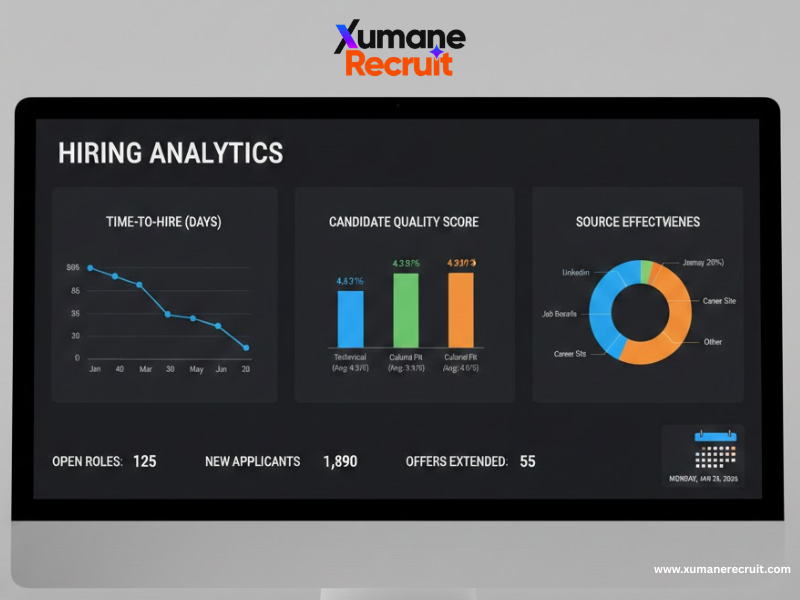
Most hiring dashboards still focus on activity metrics such as the number of applications, interviews scheduled, or offers sent. These numbers describe motion, not effectiveness. Hiring analytics moves beyond activity to outcome patterns.
In 2026, AI isn’t just automating tasks, but it’s surfacing patterns that directly influence hiring quality. Predictive analytics now forecast talent needs, identify bottlenecks inthe process, and pinpoint which sourcing channels produce the best long-term performers.
Teams can see which sourcing channels produce high performers, which interview stages cause drop-offs, and which candidate attributes correlate with retention.
Organizations using people analytics are significantly more likely to outperform competitors financially because decisions are informed by data instead of anecdotes. This change matters because it connects recruitment to business outcomes like retention, performance, and diversity, and not just fill rates or time-to-hire.
Candidate Experience Automation
Candidates interpret silence as rejection. Slow communication is one of the biggest reasons candidates abandon hiring processes. Nearly 60% of job seekers drop out when they feel the process is too long or complicated.
AI doesn’t just help recruiters but also shapes candidate experience. Automated messaging, status updates, interview reminders, and even conversational AI bots are now common. These tools help maintain engagement in a world where research indicates candidates are increasingly impatient with slow hiring processes. This creates predictability.
Predictability builds trust. Even candidates who are rejected often report a better experience when communication is timely and transparent.
AI for Inclusion, Bias Reduction, and Fairer Outcomes
Human screening is inconsistent by nature. Different recruiters may rate the same resume differently depending on fatigue, mood, or unconscious preferences. The ATS system for resumes here introduces structure. When configured responsibly, AI screening prioritizes objective attributes like skills and experience over names, schools, or other demographic factors.
Industry guides suggest that AI tools now include built-in bias mitigation features, helping organizations move closer to fairness in early filtering and shortlisting, particularly important as companies build more diverse teams. This does not eliminate bias, but it reduces random variation and provides a foundation for audits and continuous improvement.
Efficiency and Quality Gains
AI-driven recruitment isn’t theory, but it’s measurable practice. In recruiting communities, teams report significant operational improvements.
Meanwhile, adoption surveys show nearly all hiring leaders recognize AI as a key part of modern recruiting workflows, even while emphasizing that human involvement remains essential for final decisions and relationship building.
These outcomes illustrate that AI’s value isn’t in replacing recruiters,s but it’s in amplifying their capacity.
Balancing AI with Human Insight
AI handles volume. Humans handle meaning.
Despite AI’s growing role, hiring leaders consistently stress the importance of human judgment. Even as efficiency and automation improve, strategic decisions like cultural alignment, team fit, negotiation, and final offers remain human-led.
In 2026, the most effective teams combine AI’s speed and pattern recognition with recruiter expertise and intuition.
Final Thought
AI in recruitment in 2026 is no longer experimental. ATS system for resume screening automates early filtering, interview automation smoothes engagement, analytics unlocks strategic insight, and candidate experience tools keep applicants connected.
Companies that embrace this shift win not because they adopt technology, but because they use it to make smarter decisions, treat candidates with respect, and transform data into human insight.
Frequently Asked Questions
AI resume screening uses machine learning to parse and evaluate resumes based on skills and relevance, saving recruiters time and improving consistency.
No. AI automates tasks and supports decision-making, but humans still make final hiring decisions.
Yes. AI tools provide timely updates, personalized communication, and instant responses, improving engagement.
AI can reduce inconsistency and bias when properly configured and monitored, but it still requires human oversight
Teams should measure time-to-hire, cost-per-hire, candidate experience scores, and quality-of-hire outcomes.



 Tushit Pandey
Hiring right is the most important skill. After all, you bet on people, not on resumes and strategies.
Tushit Pandey
Hiring right is the most important skill. After all, you bet on people, not on resumes and strategies.