Subscribe to stay ahead with expert insights on ESOPs, smart ownership strategies, and more!
Editor's Note: If your hiring funnel is slowing down despite strong candidate sourcing, the problem may lie in interview scheduling. This guide explains how automation can streamline coordination, improve candidate experience, and significantly reduce time-to-hire.
The Hiring Problem No One Talks About
Most teams obsess over sourcing, assessments, and offers but ignore the silent bottleneck in the middle - interview scheduling.
When you multiply back‑and‑forth emails across dozens of candidates and multiple interviewers, the time cost explodes.
In 2022, recruiters were spending almost half of their time just setting up interviews. That’s half a work week on logistics instead of evaluating talent.
Automated interview scheduling exists to fix exactly this problem and to make interview scheduling in hiring faster, less error‑prone, and more candidate‑friendly.
What Automated Interview Scheduling Actually Does
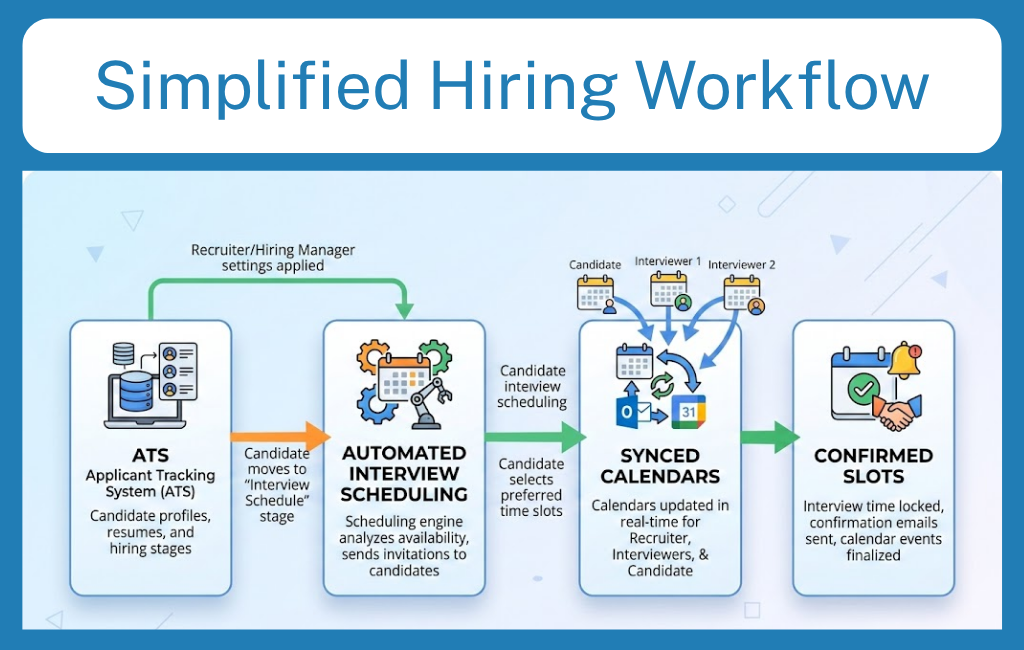
Automated interview scheduling tools connect your ATSor candidate sourcing channels to real‑time calendars. Instead of email ping‑pong, the system:
Syncs with Google, Outlook, or similar calendars to show live availability.
Let candidates choose interview slots themselves from pre‑approved windows.
Sends automatic confirmations and reminders to both sides.
Handles time zones and prevents double‑bookings.
Done well, automated interview scheduling turns a messy manual process into a self‑serve experience for candidates and a low‑touch workflow for recruiters.
Why Candidates Prefer Smart Interview Scheduling
From a candidate’s perspective, interview scheduling in hiring is often the most frustrating part. Coordinating calendars, waiting days for replies, and chasing confirmations all add friction.
With automated interview scheduling, candidates can:
Pick a time that works for them within seconds.
Receive instant confirmation instead of waiting days.
Get reminders that reduce no‑shows and last‑minute reschedules.
For talent‑scarce roles, this smoother experience can be the difference between a completed process and a quiet drop‑off.
How Automated Scheduling Speeds Up the Entire Hiring Funnel
Scheduling delays don’t just waste recruiter time; they directly extend time‑to‑hire.
A case study showed that after adopting dedicated interview scheduling software , hiring cycles dropped from 52 days to 38 days, no‑show rates fell from 18% to 7%, and recruiters saved around 8 hours per week on coordination.
For teams investing heavily in candidate sourcing, this matters. There’s no point filling the top of the funnel if slow interview scheduling in hiring causes top candidates to accept other offers before your first round even happens. Automated interview scheduling ensures that:
Shortlisted candidates are invited quickly.
Panels and multi‑round interviews are aligned with minimal back‑and‑forth.
The time between “interested” and “interviewed” shrinks dramatically.
The result is a faster, more competitive process that matches the expectations of modern candidates.
Scaling Candidate Sourcing Without Drowning in Calendars
As candidate sourcing scales through job boards, referrals, campus drives, and outbound outreach, manual coordination becomes unsustainable. Automated interview scheduling is what allows teams to scale hiring without linearly increasing recruiter workload.
Key benefits for high‑volume scenarios:
Bulk invitations: send scheduling links to dozens of candidates at once.
Group and panel coordination: align multiple interviewers’ calendars automatically.
Consistent experience: every candidate gets a clear, branded, and timely path to book time.
Advanced tools even layer in smart logic. For example, distributing interviews evenly across interviewers or prioritising certain candidate segments for faster slots. That means interview scheduling in hiring becomes a strategic lever, not an administrative burden.
Get More from One-Way Interviews—Do It Right from Day One
No. The goal is to automate logistics, not relationships. Recruiters still decide who to invite, design the interview content, and send personalised notes. Automated interview scheduling simply handles the time‑slot choreography so you can focus on conversations.
When candidates from different candidate sourcing channels can instantly book interviews, drop‑off decreases and funnel conversion improves. You get more value from the same sourcing spend because fewer candidates stall at the scheduling stage.
Yes. Modern tools can coordinate multiple interviewers automatically, find overlapping availability, and offer only valid slots to candidates, which makes interview scheduling in hiring for panels far less painful.
Real‑world examples show recruiters saving 2 to 10 hours per week, time‑to‑hire reductions of up to 40%, and noticeable drops in no‑show rates once reminders and confirmations are automated.
Not at all. Smaller teams often see the quickest ROI because they have limited recruiter capacity. Even a handful of roles can benefit when one person owns both candidate sourcing and interviews. Automation prevents that person from spending half their week on calendar management.



 Tushit Pandey
Hiring right is the most important skill. After all, you bet on people, not on resumes and strategies.
Tushit Pandey
Hiring right is the most important skill. After all, you bet on people, not on resumes and strategies.