Subscribe to stay ahead with expert insights on ESOPs, smart ownership strategies, and more!
Editor's Note: Recruitment technology is transforming how organizations attract, evaluate, and hire talent. From Applicant Tracking Systems (ATS) and AI-powered resume screening to interview scheduling and recruitment analytics, the right tools can make hiring faster, more organized, and data-driven. This guide explores the key types of recruitment technology and helps HR teams understand which solutions can best support their hiring needs.
How Technology Is Creating Better Hiring Processes
The way that organizations find labor has shifted significantly in the last ten years, and this change occurred because recruitment technology was developed. Many experts say human resources departments have stopped using manual digital tables and paper reviews to find skilled labor. Electronic systems are utilized by modern departments to manage every step from the initial search for individuals to the final arrival of new staff.
For businesses that want to stay ahead of competitors, recruitment technology is a necessary tool in a fast-moving market. It has been observed that whether a person manages a small firm or a large corporation, understanding various electronic systems helps create a better hiring process. A smarter and more effective method of selecting workers is established when these tools are understood by the leaders.
What Is Recruitment Technology?
It means the electronic programs and platforms that are used to manage and improve the process of finding labor. Many people believe that this system covers everything from the posting of job positions to the screening of documents and the scheduling of meetings.
Traditional methods of finding workers are often slow and have many mistakes, which is why recruitment technology is important for modern firms. Experts claim that human resource teams need systems that move at a high speed because the expectations of individuals seeking work are growing.
Automation and communication systems are combined within recruitment technology to create a single workflow for the office. It has been observed that human resource professionals spend less time on boring tasks when they use these systems. Strong relationships with individuals seeking work are built more easily because the computer handles the repetitive labor.
Why Recruitment Technology Matters for HR Teams?
When a strategy for recruitment technology is used, measurable benefits are brought to the organization. Many people believe that the outcomes of the labor search are improved when these digital systems are used. A better hiring process is created by these tools, even though some people prefer old methods.
Work positions are filled more quickly because automated workflows reduce the time spent on manual tasks. Experts claim that individuals seeking work stay happy when communication is smooth and updates are given on time. Manual labor is reduced when tasks like document sorting are handled by the computer.
Collaboration between managers is improved when everyone can see the same information in a central system. It has been observed that better decisions are made when teams choose individuals based on evidence. Recruitment technology is a fundamental foundation of modern strategy instead of being a simple choice for a firm.
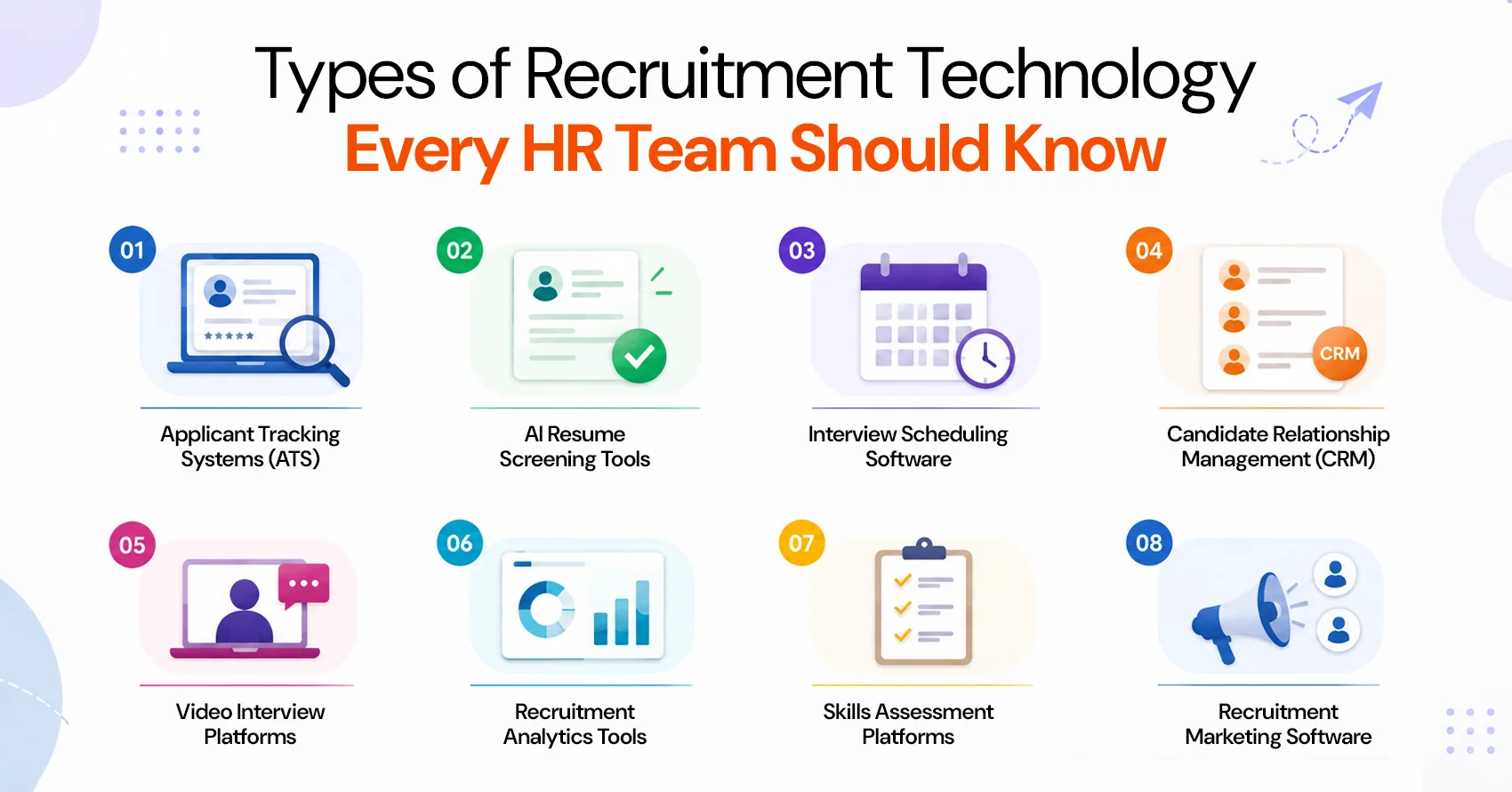
Types of Recruitment Technology Every HR Team Should Know
Various forms of recruitment technology exist today because different hiring challenges must be solved by the staff. Many experts claim that understanding these groups helps a firm select the best combination of electronic tools. The right technology is chosen when the needs of the department are clearly identified.
Applicant Tracking Systems (ATS)
Software known as an Applicant Tracking System manages documents and job advertisements in a single place. It has been observed that large amounts of data are organized by this specific system while the candidates are tracked through every stage. A searchable database for future working positions is maintained by the software so that information is never lost.
A company that is growing uses an Applicant Tracking System when applications need to be sorted for specific working positions. Experts claim that many hours of manual labor are saved each week when the software sorts the incoming names. The foundation of most hiring systems is formed by the Applicant Tracking System among the many types of recruitment technology.
AI Resume Screening Tools
AI resume screening tools utilize mathematical instructions because professional profiles must be examined to find matching individuals seeking employment for specific working positions. Many people believe that AI resume screening tools assist personnel management departments in finding qualified applicants when manual reading of every document is impossible. Because some roles receive hundreds of submissions, AI resume screening tools allow the shortlisting of individuals seeking employment based on specific keywords. It has been observed that recruiters focus on the best matches after the AI resume screening tools provide the list.
Interview Scheduling Software
Interview scheduling software simplifies the arrangement of meeting times between individuals seeking employment and hiring groups through technological automation. Experts claim that interview scheduling software prevents the exchange of many digital messages because the technology connects digital calendars. While available slots are selected by the applicant, delays are avoided by interview scheduling software. A personnel management manager who interviews five individuals in one week relies on interview scheduling software so that manual communication is removed.
Candidate Relationship Management (CRM)
A Candidate Relationship Management system provides assistance to personnel management groups as they create long-term connections with potential hires. Because information is stored within the Candidate Relationship Management system, previous interactions are tracked to support communication that is personalized. Many people believe that the Candidate Relationship Management system is useful for nurturing passive individuals seeking employment even when those individuals are not currently applying for a working position. A talent pipeline is kept ready by the Candidate Relationship Management system for future openings.
Video Interview Platforms
Video interview platforms permit personnel management groups to hold digital meetings from distant locations. Because time and travel costs are saved by video interview platforms, hiring teams evaluate individuals seeking employment who live in different places. It has been observed that video interview platforms are effective for conducting initial discussions before a face-to-face meeting occurs. Shortlisted individuals are invited for in-person talks after the video interview platforms are used for screening.
Recruitment Analytics Tools
Recruitment analytics tools monitor hiring metrics like the duration of the hiring process and the rate at which individuals seeking employment stop their application. These data points help personnel management groups recognize obstacles so that better choices are made during the selection process. Experts claim that recruitment analytics tools show where most individuals seeking employment leave the process, which forces teams to make the assessment stage easier. Decisions that are backed by data are supported by recruitment analytics tools.
Skills Assessment Platforms
Skills assessment platforms evaluate individuals seeking employment on specific abilities like writing or solving problems. Because real capabilities are measured by skills assessment platforms, personnel management groups do not need to rely only on professional profiles. Many people believe that skills assessment platforms confirm that only qualified individuals move forward when technical abilities are tested before the formal discussion. Accuracy in hiring is improved because skills assessment platforms provide evidence of talent.
Recruitment Marketing Software
Recruitment marketing software assists organizations when job openings are promoted to increase awareness of the employer brand. Because tasks like managing career websites and running specific job advertisements are handled by recruitment marketing software, engagement with individuals seeking employment is tracked. It has been observed that recruitment marketing software allows a company to show workplace culture on social platforms to attract individuals who share company values. Targeted campaigns are managed through recruitment marketing software to reach the right people.
How to Choose the Right Recruitment Technology?
Selecting the appropriate recruitment technology relies on different elements that are specific to an organization. Small teams might require simple systems, while large organizations need advanced tools. When the volume of hiring is high, automation is utilized by recruitment technology to assist with screening. Integration is necessary because recruitment technology must connect with existing digital systems to prevent data isolation. Experts claim that strong reporting features help teams make decisions using data, while intuitive interfaces ensure that recruitment technology is adopted quickly. Scalability is also needed so that recruitment technology grows with the organization.
Final Thoughts
Recruitment technology changes the ways personnel management groups find and select talent. Because each tool serves a specific purpose, an efficient hiring process is built by recruitment technology. Many people believe that selecting the correct combination of recruitment technology depends on the goals and size of the organization. Because personnel management groups understand the different types of recruitment technology, better decisions are made to improve the speed and quality of hiring. It has been observed that recruitment technology provides a modern way to manage human resources.
Frequently Asked Questions (FAQs)
Digital instruments and software that assist human resources departments are known as recruitment technology. Recruitment technology helps organizations when they find new staff and welcome those staff members into the workplace. Work becomes better because recruitment technology reduces manual work. Many people believe that recruitment technology permits data to guide choices. Decisions about hiring become stronger when recruitment technology uses information. Because recruitment technology creates a positive feeling for individuals, recruitment technology remains significant for the modern educational institution. It has been observed that recruitment technology reduces the heavy workload on human workers.
Organizations utilize various specific systems within the category of recruitment technology to find individuals with low income or high skills. Applicant Tracking Systems (ATS) and AI resume screening software are frequently employed by teams. Experts claim that interview scheduling platforms and candidate relationship management (CRM) systems assist in organizing the flow of people. Video interview platforms, along with recruitment analytics tools, provide deep knowledge about the individuals. Skills assessment platforms and recruitment marketing software also exist as parts of recruitment technology.
Repetitive actions are handled by recruitment technology so that humans can focus on more difficult problems. Tasks like screening documents are finished quickly by recruitment technology. Because recruitment technology handles candidate communication, the speed of the hiring journey increases. Collaboration between team members is improved when recruitment technology shares information. It has been observed that informed choices are made more often because recruitment technology presents clear evidence. A better experience is felt by candidates because recruitment technology keeps the process moving. Recruitment technology ensures that every step follows a logical path which reduces time.



 Vijay Kumar
Hiring right is the foundation of every successful organization.
Vijay Kumar
Hiring right is the foundation of every successful organization.