Subscribe to stay ahead with expert insights on ESOPs, smart ownership strategies, and more!
Editor's Note: 10 major AI recruiting platforms influencing high-volume hiring in 2026 are explored in this blog. This blog will help recruiters, HR directors, and entrepreneurs looking for the best AI recruiting software to hire talent faster and with ease.
Why Is Having an AI Recruiting Software Essential in 2026?
Large-scale hiring has never been more difficult. Traditional sourcing techniques are simply unable to keep up with the rapidly increasing application volumes and fiercer competitionfor top people. AI recruiting technologies can help with this by automating tedious activities, increasing match accuracy, and freeing up recruiters' time to concentrate on what really matters - human connection.
In just a few minutes, contemporary AI systems can evaluate thousands of applications, spot trends, and even forecast candidate success. The best AI recruiting software is now a strategic requirement for companies that handle hundreds or thousands of hires annually.
What Makes a Great AI Recruiting Platform?
It's important to know what makes the top AI recruiting tools different from the others before digging into the top options. A robust platform ought to:
Provide explainable AI results so hiring managers can have confidence in the choices made.
Personalization and communication automation can improve the candidate experience.
Provide sophisticated analytics to gauge hiring quality, cost per hire, and time to hire.
10 Best AI Recruiting Software of 2026 for High-Volume Sourcing
1. Paradox Olivia
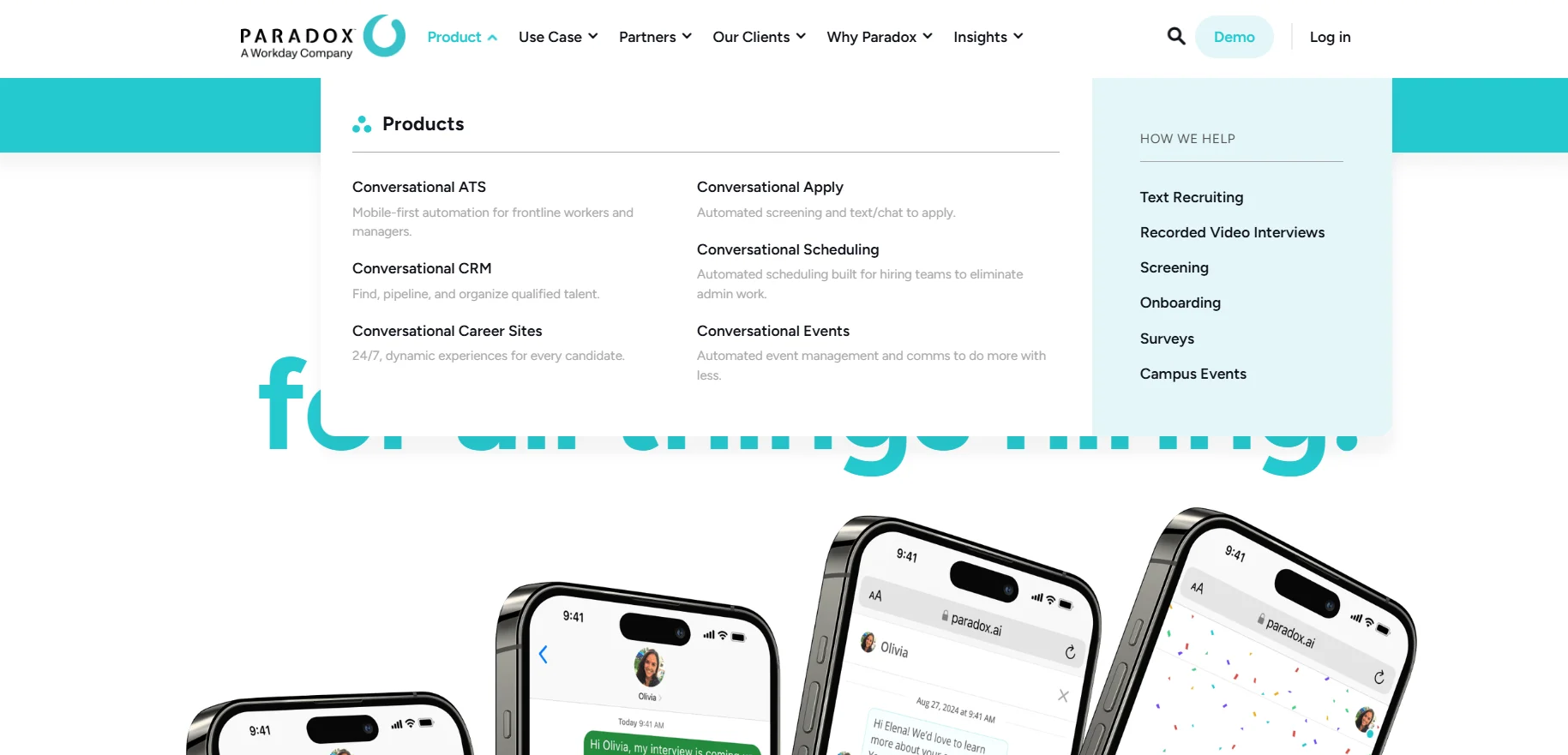
Paradox Olivia is a conversational AI assistant made for employing large numbers of people. It manages initial screening, arranging interviews, and follow-up, all of which are integrated with your applicant tracking system. It also automates candidate engagement via chat or text.
Pros:
Allows recruiters to concentrate on strategy by automating monotonous chores like scheduling and screening.
Strong calendar and ATS integration, perfect for hundreds of candidates
Cons:
Exorbitant costs. Not suitable for small businesses or low hiring numbers.
Confusion with automated interactions (less human touch) has been noted in some candidate reviews.
Strong data/integration infrastructure is needed.
Pricing:
Available on request.
2. Xumane Recruit
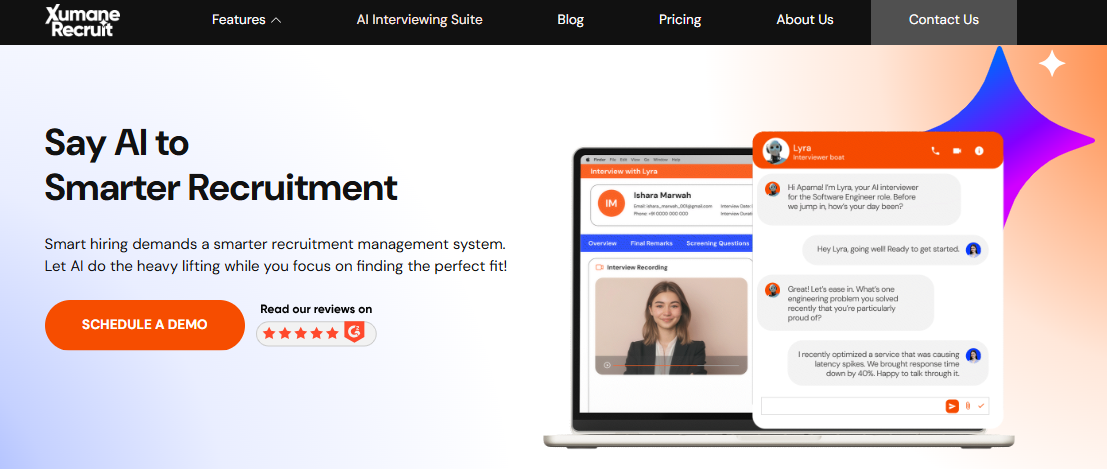
Xumane Recruit is an excellent platform for AI-driven hiring. It helps screen and score candidates, conduct interviews, and evaluate candidates end-to-end. The platform particularly leads in adaptive AI interviewing and sentiment analysis. It offers dashboards that provide a clear overview of the candidate's strengths, weaknesses, and whether the tool recommends the candidate or not.
Advantages:
It offers hiring features at a fraction of the cost of legacy platforms
Its support team really listens to you and solves/addresses queries at the earliest
Transparent JD and CV scoring along with AI-driven fitment badges
Offers interview summaries and auto-generated reports
Cons:
Needs more integration options
Too many capabilities may overwhelm smaller teams
Pricing:
Let’s talk. We offer need-based plans tailored to the features your hiring team requires.
3. HireVue
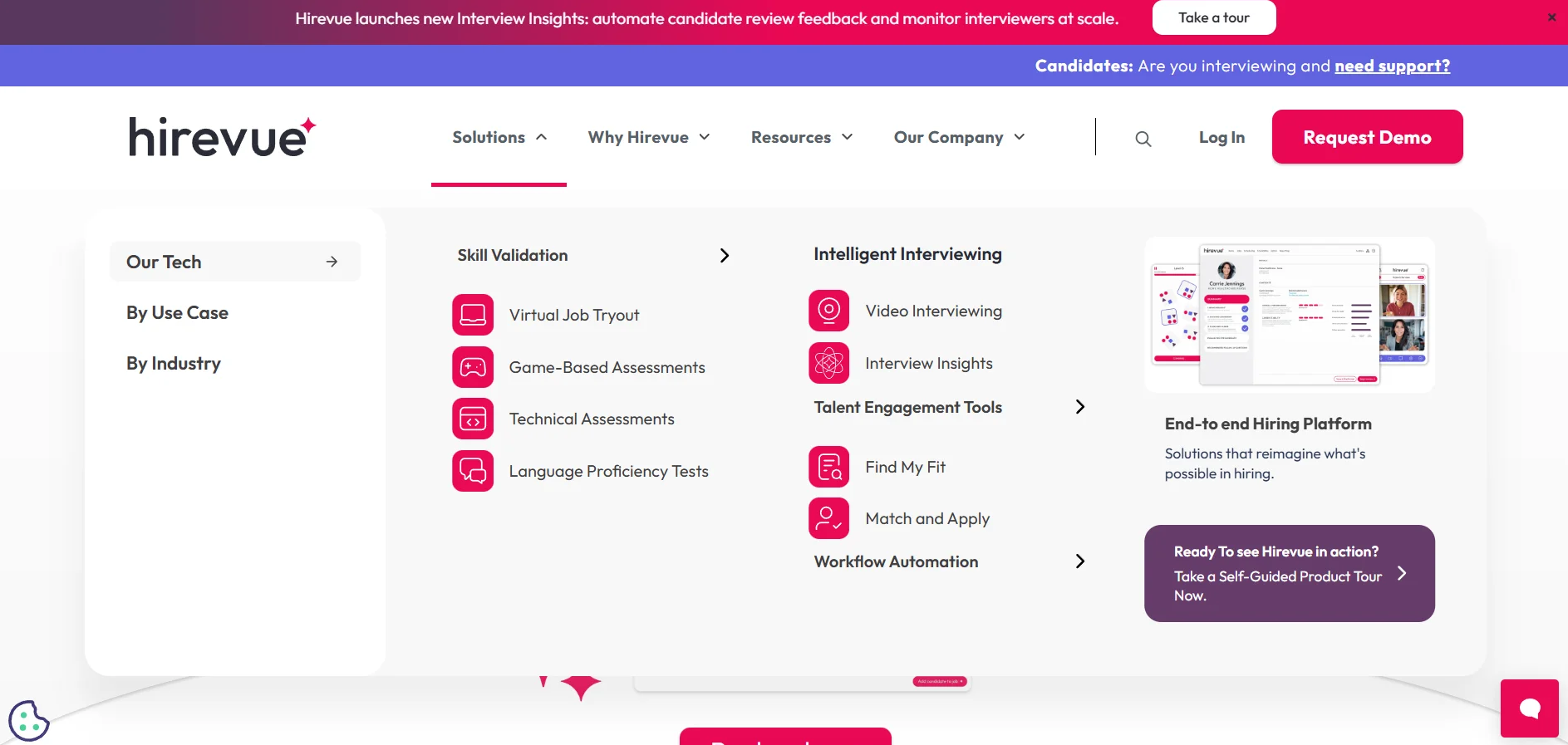
HireVue is a top AI-powered video interviewing and evaluation tool designed for businesses that hire a lot of people and need predictive analytics, automated candidate scoring, and thorough screening.
Advantages:
Enables efficient workflows across huge personnel pools by integrating with major ATS systems.
Provides analytics that help accelerate recruiting and enhance the quality of candidate-to-hire matching.
For companies hiring thousands of people, enterprise-level security, compliance, and candidate experience are crucial considerations.
Cons:
Prices start at about $35,000 per year, which makes it less affordable for smaller businesses.
Due to the platform's extensive feature set, considerable training and ramp-up time may be needed.
Increased automation may lessen the human element in initial encounters with candidates, which, if not handled appropriately, could affect employer brand.
Pricing:
Available on request.
4. SeekOut
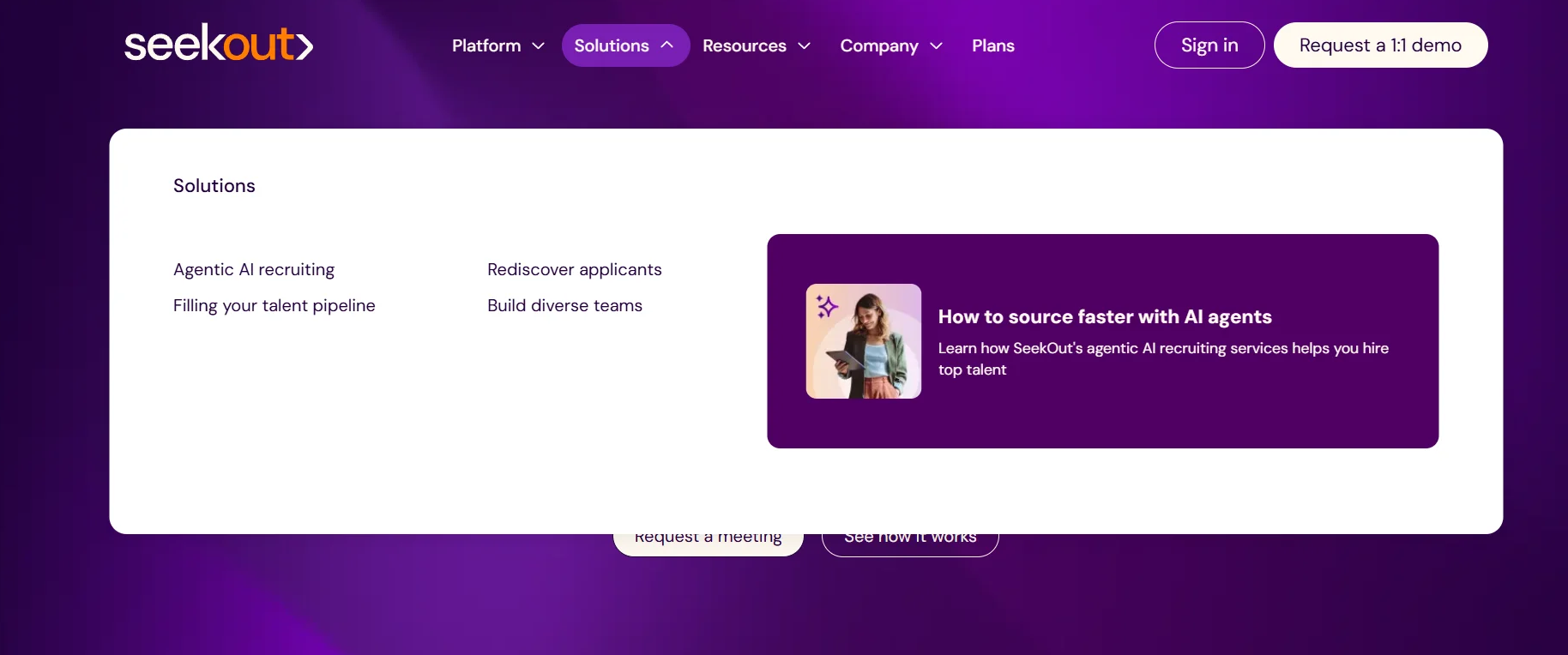
For businesses that need to locate specialized or difficult-to-reach talents at scale, SeekOut is an amazing AI-driven talent intelligence and sourcing platform. It gathers information from various open sources and adds expertise, diversity insights, and skills to candidate profiles.
Advantages:
Great for finding passive candidates in international networks.
Robust diversity analytics that enable teams to achieve DEI objectives carefully.
Cons:
Designed more for sourcing than for full-cycle hiring.
New users may find the complexity of filters intimidating.
Pricing:
Available on request.
5. Eightfold AI
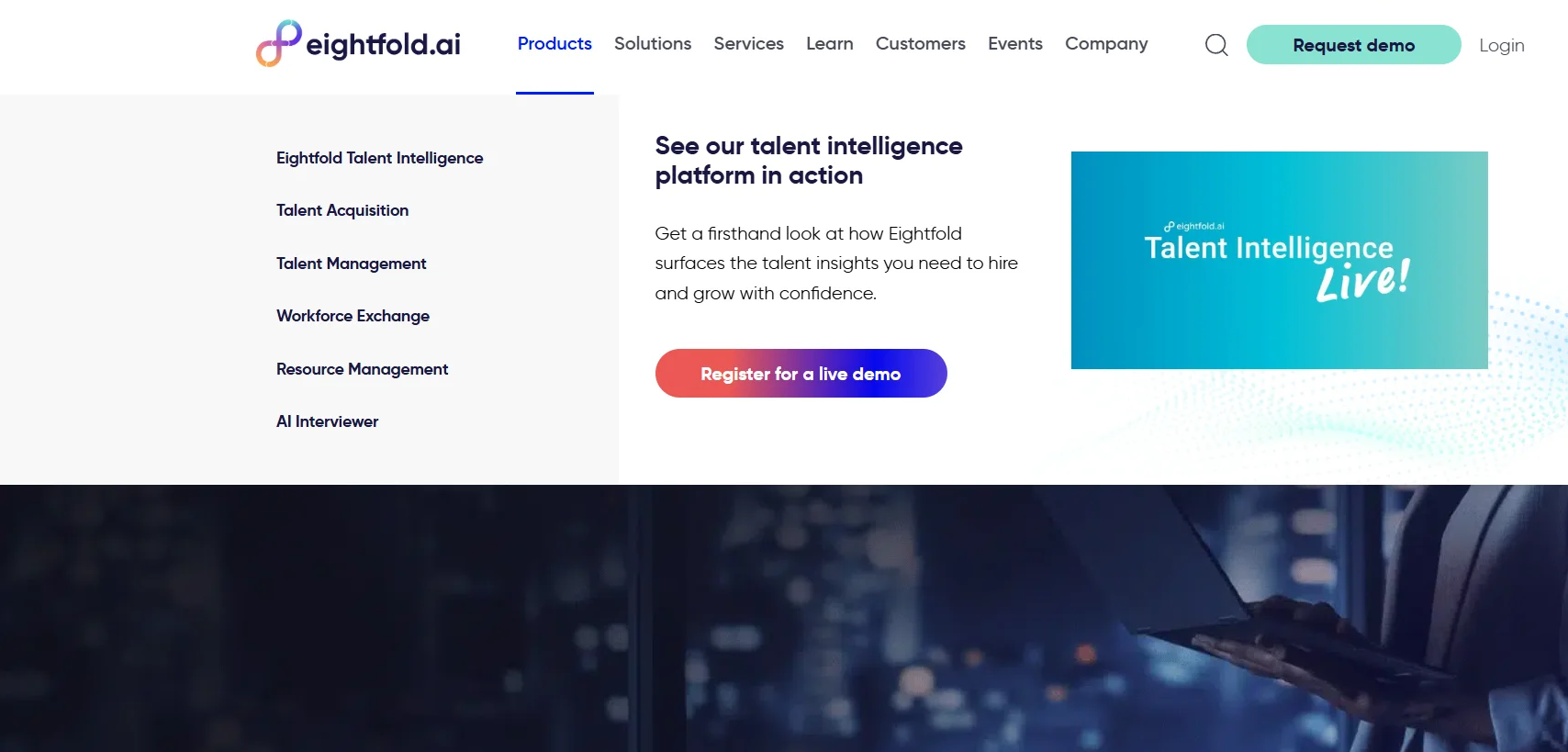
Eightfold is a deep-learning talent intelligence tool that is perfect for large-scale hiring or internal mobility initiatives. It connects applicants based on skills and potential. In fact, its predictive talent matching is based on potential rather than just previous titles.
Advantages:
Strong internal mobility and workforce planning modules.
Great for companies wanting to reskill and upskill employees.
Cons:
Costly and positioned for mid-to-large enterprises.
Heavy implementation workload, requires strong data quality.
Not ideal for small businesses with low-volume hiring.
Pricing:
Available on request.
6. HireEZ
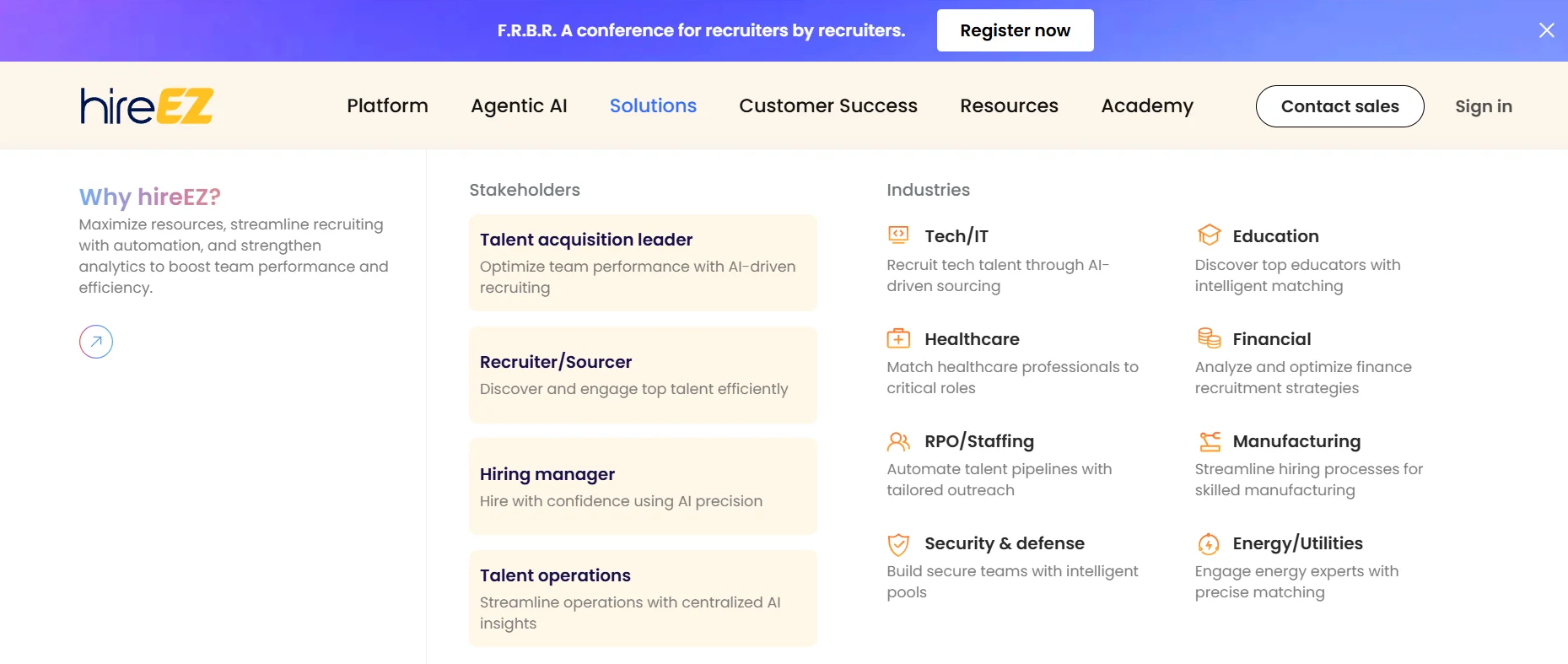
HireEZ focuses on outbound sourcing. Its AI scans talent across the open web, builds rich profiles, and highlights people who actually fit the role instead of just matching keywords. You get market insights, skill interpretation, and clear signals on who’s likely to engage.
Advantages:
30+ platform integrations with deep web search capability.
Robust CRM and ATS connections.
Cons:
Better suited for sourcing than complete hiring processes.
External sources are necessary for data accuracy.
It can get pricey when there are several seats.
Pricing:
Available on request.
7. HiredScore
HiredScore applies AI to streamline high-volume hiring. It reads resumes, scores candidates, and flags strong fits based on skills, experience, and internal patterns from past successful hires. The platform also helps with talent rediscovery by surfacing qualified people already in your system. Recruiters get a clear dashboard with fit scores, risks, and recommended next steps, making it easier to prioritize who to review and move forward.
Advantages:
Excellent controls for fairness and compliance in regulated businesses.
Excellent compatibility with enterprise HRIS/ATS systems.
A track record of success with Fortune 500 firms worldwide.
Cons:
Implementation is complicated and calls for enterprise IT collaboration.
Not appropriate for small businesses.
more expensive than mid-market tools.
Pricing:
Available on request.
8. Fetcher
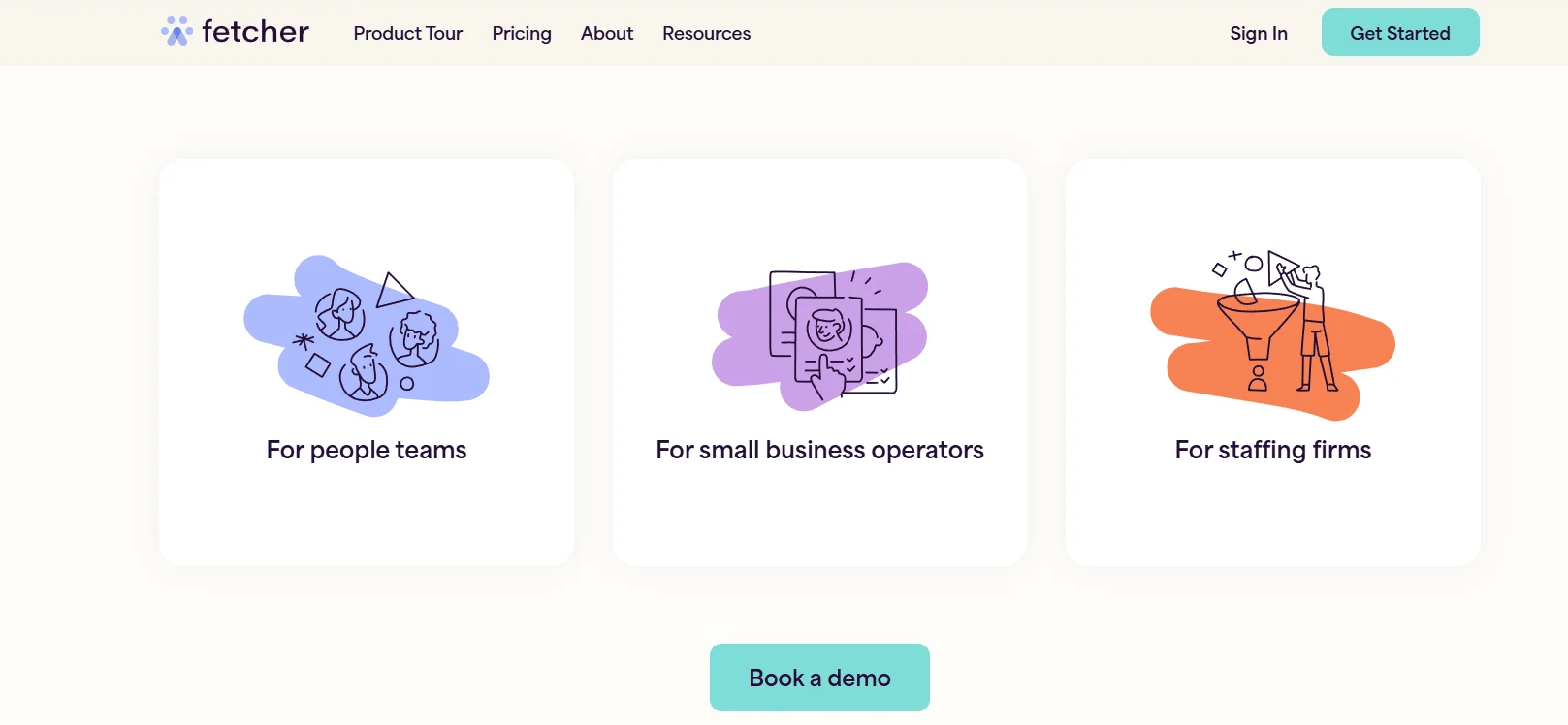
Fetcher centers on automated sourcing backed by a human-in-the-loop team. Its AI pulls in candidates from across the web, but every batch is hand-reviewed before it reaches you, which reduces noise and keeps quality high. The tool also learns from your yes/no feedback, so each new round gets closer to what you actually want.
Advantages:
Ideal for SMEs and startups that source in large quantities.
Recruiters can save hours every week by using automated outreach.
Simple interface with little learning curve.
Cons:
Not as appropriate for executive or highly technical positions.
strong reliance on email delivery.
restricted ATS-style features.
cost:
Their Growth plan starts at $379/month.
Their Amplify plan starts at $649/month.
9. Arya by Leoforce
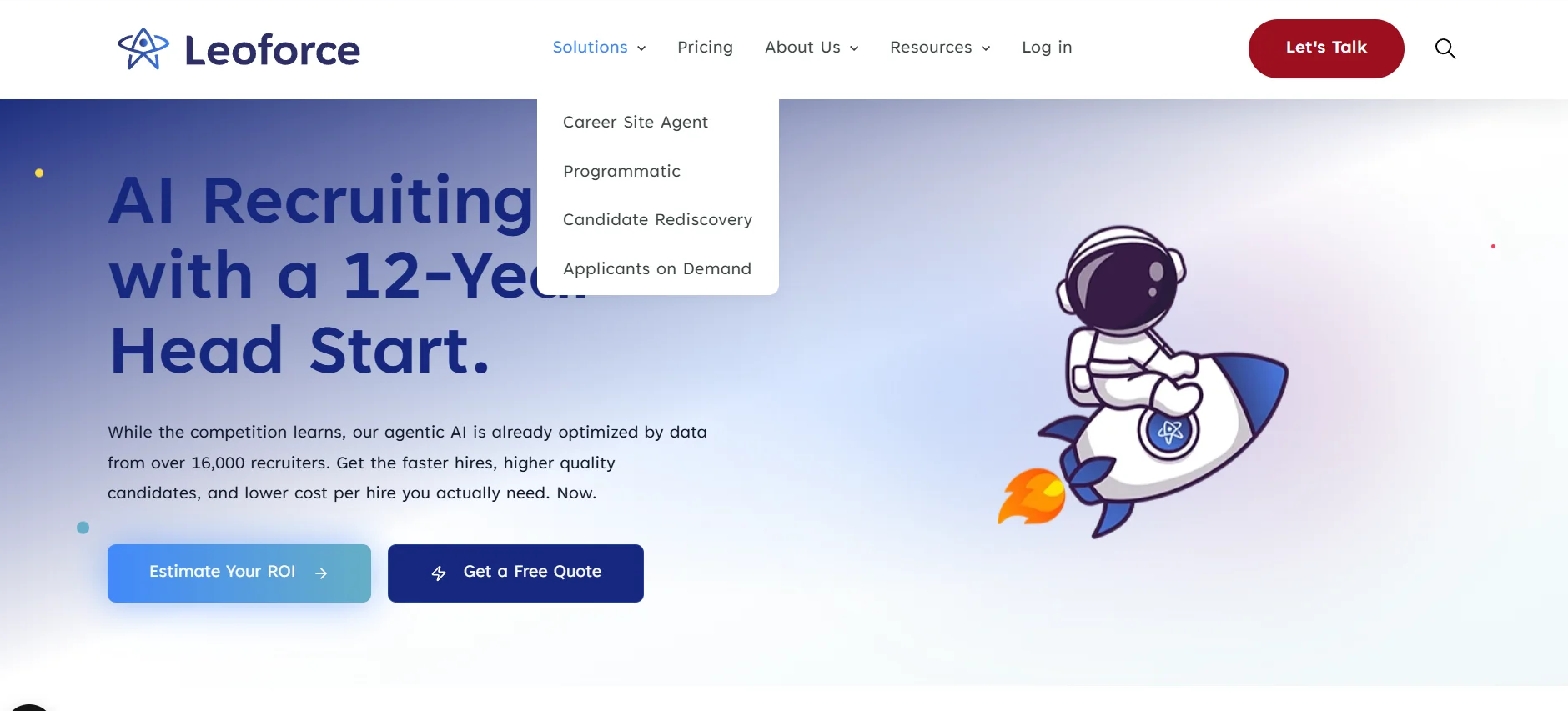
Arya by Leoforce leans heavily on predictive talent matching. Its AI doesn’t just scan resumes; it studies patterns from millions of career paths to understand who’s likely to succeed in a given role. That’s its real edge. It blends skills, behavior signals, and historical hiring data to produce matches that feel more intentional than a basic keyword pull.
Advantages:
Strong AI matching capabilities are a plus.
Excellent for organizations that want automation for bulk sourcing.
Provides both internal talent rediscovery and external sourcing.
Cons:
In comparison to more recent tools, the UI seems a little out of date.
For enterprise workforce analytics, it is weaker.
Feedback from customer service is inconsistent.
Pricing:
Available on request.
10. Manatal
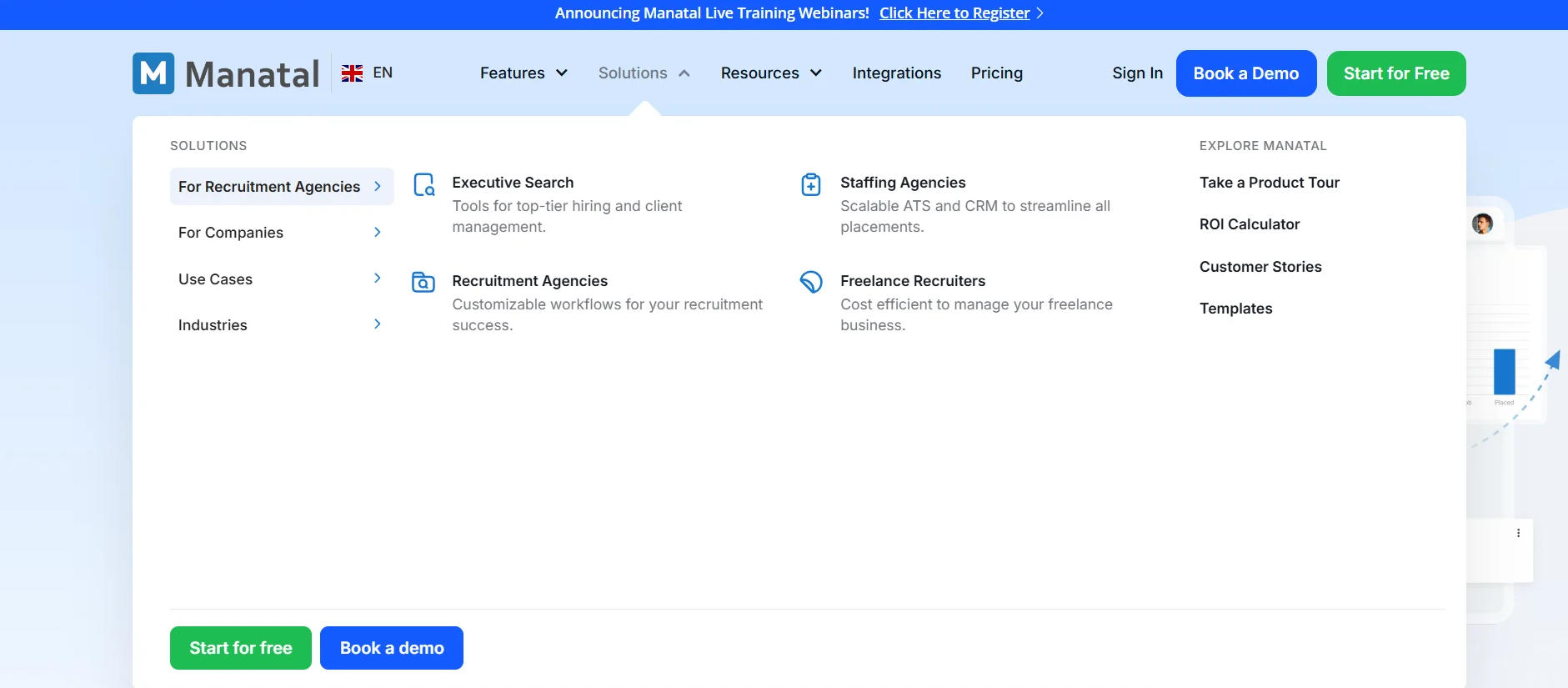
Manatal stands out for its ease of use and the way it layers AI on top of a clean, lightweight ATS. Its biggest strength is how quickly recruiting teams can get up and running without feeling buried in complex workflows. The AI helps enrich profiles, suggest candidates, and highlight the best fits based on skills and background, but the interface keeps everything simple.
Advantages:
Easy to use and quick to set up.
Robust AI matching recommendations for shortlisting.
Less expensive than the majority of AI platforms.
Cons:
While useful, AI recommendations lack the sophistication of top-tier technologies.
Enterprise workflows have limited customization options.
Dashboards for reporting are good but not very detailed.
Pricing:
Plans start at $15 per user per month (billable annually).
Pro plans with more features cost about $35 per user per month.
Enterprise Plus plan starts at $55 per user per month.
Custom pricing available.
Why High-Volume Recruiters Need AI?
High-volume sourcing comes with unique challenges: repetitive screening, communication delays, and overwhelmed recruiters. Using top AI recruiting software helps by:
Identifying hidden talent faster through predictive matching.
Automating candidate engagement to improve response rates.
Enhancing data accuracy in hiring pipelines.
AI hiring technologies enhance human workers rather than replace them. Recruiters receive improved alignment with business objectives, quicker replies, and deeper insights.
Key Benefits of AI Recruiting Software
1. Efficiency: Shortlisting and sourcing are automated, allowing recruiters to concentrate on strategy and cultural fit.
2. Scalability: Easily manages high application numbers, making it ideal for international hiring efforts.
3. Bias Reduction: Standardization of evaluation criteria is aided by machine learning techniques.
4. Data-Driven Insights: Over time, sourcing techniques are improved by ongoing learning from hiring data.
5. Candidate Experience: Employer brand perception is enhanced by quicker feedback and more efficient communication.
Implementation Tips for 2026
To maximize ROI, approach AI adoption as a process, not a plug-and-play solution:
Start with pilot projects in high-volume roles.
Train recruiters to interpret AI results critically.
Ensure ethical data handling and transparency in AI decisions.
Integrate AI insights into broader HR analytics dashboards.
These steps ensure your AI stack enhances and does not disrupt your recruitment workflows.
The Future of AI Recruiting
By 2026, AI hiring will focus on intelligence and flexibility rather than just speed. The greatest solutions will combine human-centric design with predictive analytics, enabling hiring teams to anticipate worker requirements rather than just respond to them.
Early adoption of AI recruiting technologies by recruitment directors will result in quantifiable increases in candidate happiness, hiring speed, and quality. The ability of businesses to successfully combine technology and human judgment will be a crucial difference as AI develops.
Frequently Asked Questions (FAQ)
Artificial intelligence and machine learning are used by AI recruiting software to automate processes such as candidate sourcing, screening, and ranking. Using natural language processing and predictive analytics, it helps recruiters find qualified applicants more quickly.
Your company's needs and size will determine which AI recruiting tools are suitable. While solutions like Fetcher and Manatal are better suited for startups or agencies managing mid-volume recruitment, platforms like Paradox Olivia and Xumane Recruit are perfect for hiring on an enterprise scale.
Artificial intelligence (AI) solutions can eliminate human bias in candidate selection, automate communication, and reduce screening time by up to 70%. They facilitate more efficient, data-driven hiring processes for recruiters and candidates by interacting with application tracking systems (ATS).
Not always. Scalable pricing is available on many of the best AI recruiting software platforms, depending on the amount of recruits or user seats. Companies usually save money over time through fewer recruiter hours and higher-quality hiring, even though the initial expenditure may be more than with traditional methods.



 Tushit Pandey
Hiring right is the most important skill. After all, you bet on people, not on resumes and strategies.
Tushit Pandey
Hiring right is the most important skill. After all, you bet on people, not on resumes and strategies.