Subscribe to stay ahead with expert insights on ESOPs, smart ownership strategies, and more!
Editor's Note: The insights shared in this blog highlight the growing role of AI staffing solutions in today’s recruitment ecosystem. By adopting AI powered recruiting and advanced sourcing tools, staffing and recruiting companies can stay competitive and deliver better hiring outcomes.
Introduction
Staffing and recruiting companies are operating in a market with tighter budgets and skills that are evolving at 10x speed. The tough part? Candidates expect consumer-grade digital experiences. And, they’re not wrong.
But, at the same time, clients demand faster role fills and a stronger fit for targeted performance metrics instead of just high CV volume. Firms are realizing that they need a robust AI staffing platform as a core infrastructure to support their hiring needs. So, no, these systems cannot be treated as experimental anymore.
It’s worth noting that the use of AI in HR and recruiting has roughly increased to 55% in the last 2 years. A majority of organizations are now using AI (especially for the initial parsing and screening processes) in their day-to-day hiring processes. So, for companies, the action item now is how to implement AI-powered recruiting in a way that improves overall outcomes.
Benefits of AI Staffing
Where does AI help most when it comes to hiring? That would be in AI candidate sourcing, screening, and engagement workflows.
AI sourcing systems mine your existing ATS/CRM , re‑index historical applicants, and automatically surface high‑fit candidates, often cutting time‑to‑hire by one fourth. This lets smaller teams get work done on a much wider scope, like a much larger sourcing team, while getting more value from the data they already own. Useful, right?
What more? Modern AI staffing platforms also automate resume parsing, skills extraction, and first‑round screening questions, turning raw profiles into ranked shortlists with transparent best-fit scores. This way, recruiters can concentrate on human work like clarifying goals and outcomes, selling opportunities, and building long‑term relationships. AI‑driven chatbots and sequenced outreach keep candidates warm, answer FAQs, and schedule interviews , reducing drop‑off in high‑volume segments like healthcare, retail, and junior IT.
Competing Smarter with Outcome‑Based AI
The most competitive staffing and recruiting companies are shifting from feature‑based buying to outcome‑based AI strategies. They link every AI-powered recruiting initiative to specific KPIs such as time‑to‑submit, interview‑to‑offer ratio, client fill‑rate, and retention at 90 days. If a model or workflow does not improve one of these numbers, they refine it or switch to a different tool.
For example, firms that deploy AI candidate sourcing across their ATS and add AI‑assisted pre‑screening often report 70% cut in time‑to‑fill and large reductions in manual screening hours. That performance gain translates directly into higher client satisfaction and better odds of winning or retaining MSP and RPO contracts. Buyers are increasingly evaluating AI vendors based on measurable lift in recruiter productivity, quality of hire, and candidate experience, rather than on long feature lists.
Implementing AI in Staffing
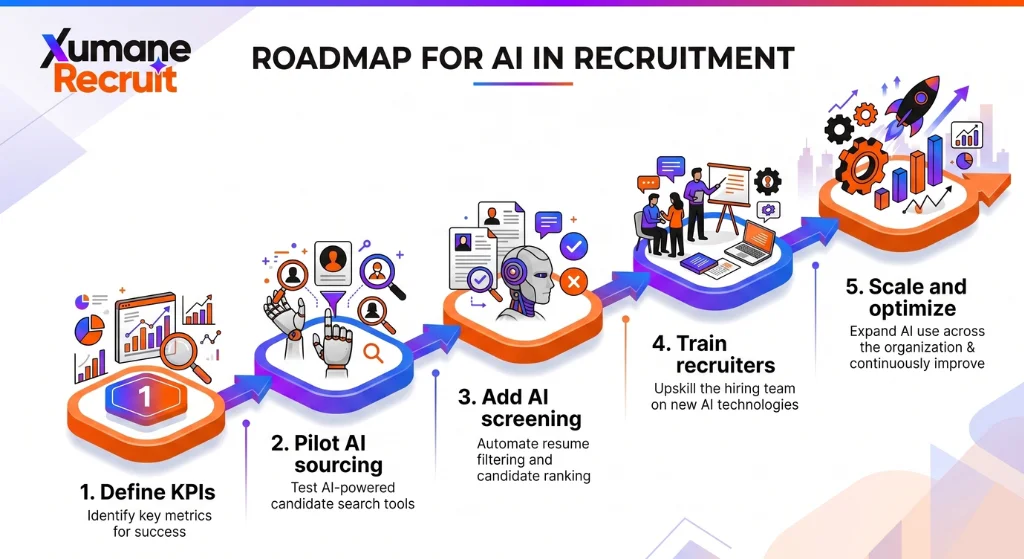
Successful AI adoption in staffing and recruiting companies usually follows a phased, low‑risk rollout rather than a big‑bang transformation. First, leaders select one or two bottlenecks, such as slow sourcing for niche skills or high recruiter burnout. Then, they lock in baselines for time‑to‑fill, cost‑per‑hire, and submittal‑to‑hire ratio.
Next, firms test AI candidate sourcing on their own database, then layer in AI‑assisted screening and scoring for one vertical or client segment. Human recruiters stay firmly in the loop, validating recommendations and teaching the system what good AI utilization looks like. Compliance and fairness are addressed by choosing vendors that support explainability and bias monitoring and by training teams on responsible AI use. Once pilots show clear KPI improvements, firms standardize the new workflow, train the team on it, and integrate AI deeply with their ATS/CRM for the best results.
How Firms Can Stay Ahead in 2026
By 2026, most staffing and recruiting companies will be AI‑enabled. The real differentiator will be how well a company utilizes AI. Firms that transform their hiring practices (shorter hiring cycles, better candidate selections) and attain the full ROI of such tools are the ones that attain a transparent and human‑centric perspective in front of clients and candidates. They convert AI capabilities into visible business value in the form of shorter hiring cycles, better matches, lower attrition, and improved, data‑driven reporting.
For leaders, the strategic question is where AI-powered recruiting can deliver an unfair edge in their specific markets and how to align people, process, and technology around that. Agencies that invest deliberately in AI candidate sourcing, decision support, and recruiter enablement rather than chasing tools for their own sake will be the ones that truly compete smarter in 2026.
AI staffing tools automate manual tasks like resume parsing, skills tagging, basic screening, scheduling, and candidate follow‑ups, so recruiters can spend more time on high‑value work such as relationship building, client consulting, and final selection. This typically reduces time‑to‑fill and recruiter burnout while improving consistency in early screening.
AI candidate sourcing uses machine learning to scan internal databases, job boards, and public profiles, automatically identifying, ranking, and engaging candidates who are likely to be a strong fit for open roles. Done well, it can cut time‑to‑shortlist by up to 70 percent and uncover high‑quality “hidden” candidates your team has already engaged but lost track of.
No, current best practice is to use AI powered recruiting as decision support, not a full replacement for human judgment. AI speeds up sourcing and screening, but humans still set hiring criteria, review edge cases, manage offers, and build the trust‑based relationships that win and retain clients and candidates.
Key risks include biased or opaque algorithms, poor workflow fit, low recruiter adoption, and potential non‑compliance with emerging AI‑in‑hiring regulations. Firms can reduce these risks by choosing explainable tools, establishing clear governance and an AI playbook, and keeping humans in the loop for high‑impact decisions.
The most reliable way is to track changes in specific KPIs such as time‑to‑fill, cost‑per‑hire, recruiter productivity, candidate drop‑off, and 90‑ or 180‑day retention before and after implementation. Leading agencies also monitor qualitative metrics like candidate experience scores and client satisfaction to ensure AI is improving outcomes, not just increasing automation.



 Tushit Pandey
Hiring right is the most important skill. After all, you bet on people, not on resumes and strategies.
Tushit Pandey
Hiring right is the most important skill. After all, you bet on people, not on resumes and strategies.